
Immigration and Policy Updates from Washington D.C.
Pasifika Immigration Briefing
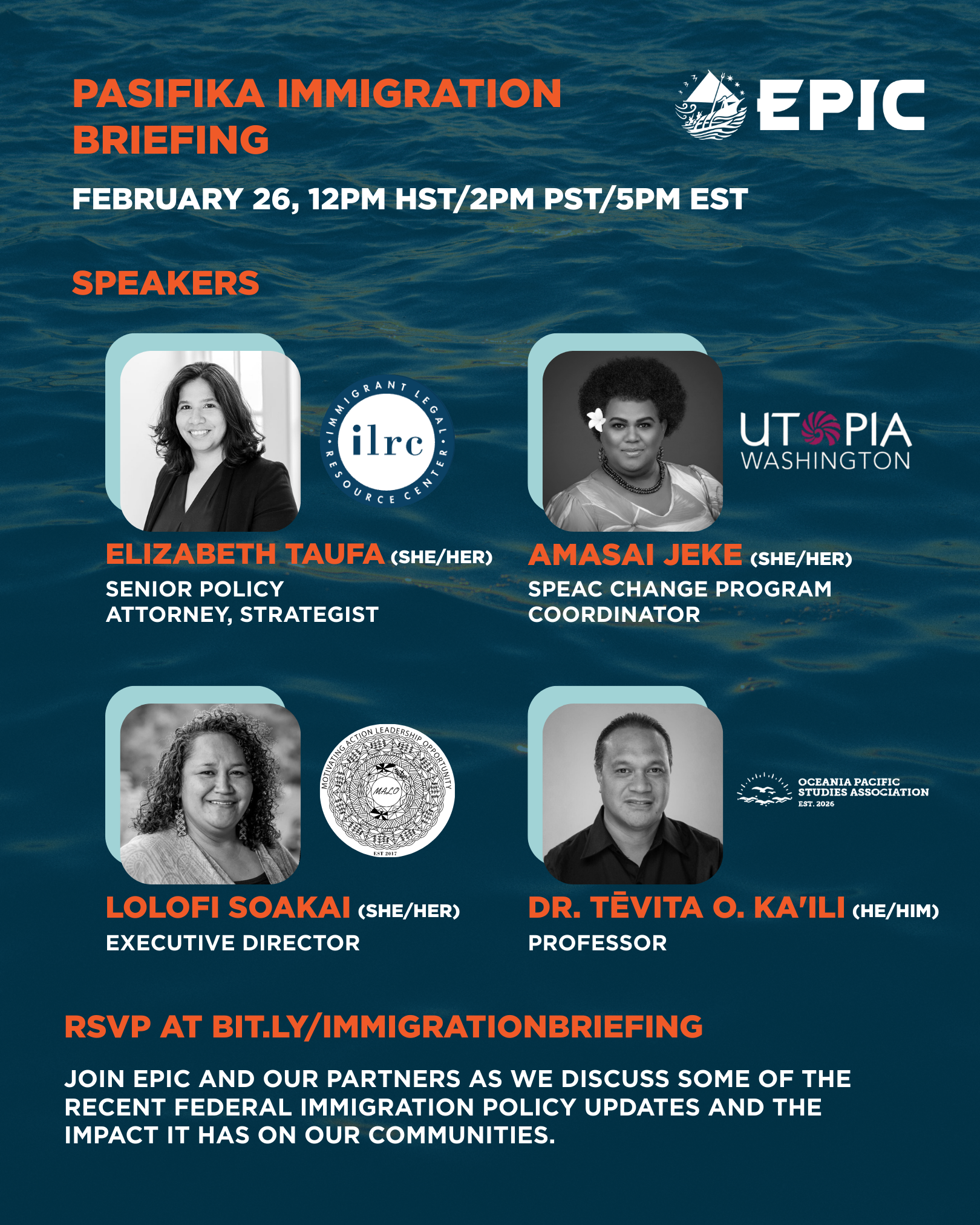
Given recent immigration policy changes—including the partial travel ban on Tonga and the visa suspension affecting Fiji—our kuleana is to inform our community about these changes and empower them to take action.
This comes amid ongoing ICE enforcement, detention, and deportation efforts that are harming not only immigrants, but also citizens who stand up to protect them. At the same time, Congress is negotiating a budget for DHS, with proposals that could allocate even more funding to ICE—the most heavily funded law enforcement agency today.
Join us for our upcoming Pasifika Immigration Briefing on February 26 at 5:00pm ET by filling out this form.
IMMIGRATION
DHS Appropriations Temporarily Funded
Congress briefly entered a partial government shutdown on January 30th after the Senate blocked funding for the Department of Homeland Security (DHS), citing ongoing accountability failures within ICE and widespread public outrage over deadly immigration operations earlier this year.
The deaths of Minnesota residents Renee Good and Alex Pretti–killed in ICE operations in January– intensified calls for congressional action and reform within DHS and its component agencies.
In response, Congress amended H.R. 7148 - The Consolidated Appropriations Act of 2026, passing five funding bills, alongside a short-term continuing resolution for DHS, instead of a sixth full funding bill. It passed in both chambers and signed into law on February 3rd.
The continuing resolution allows DHS to operate at current funding levels, while Congress negotiates DHS oversight, ICE operational standards, and broader accountability reforms. They have until Friday, February 13th.
Sign onto this letter to urge members of Congress to stop all DHS funding until all violence, abuses, and deaths in our communities and detention centers stop. Accountability must be prioritized to ensure transparency, oversight and protection of human life and civil rights.
Visa Processing Changes Affecting Tonga and Fiji
New travel and visa restrictions took effect in January, expanding the Trump administration’s travel ban. Tonga is now under a partial ban, halting new visitor, student, and business visas that will not be issued during the ban (B-1; B-2; F; M & J visas).
Additionally, the Department of State has paused immigrant visa processes for 75 countries–including Fiji-while reviewing the “public charge” test, which determines if an applicant for U.S. admission might rely on public benefits. The review is expected to be stricter than before, now considering standards based on factors like age, health, English language proficiency, finances, education-raising new barriers for families seeking entry to the U.S.
What this means:
The travel ban applies only to foreign nationals outside the U.S. without a valid visa as of January 1; current visa holders are not directly affected but should travel with caution due to possible re-entry issues. New visa applications and interviews are still accepted, but no visas—temporary or immigrant—will be issued during the ban or visa freeze. These policies disrupt families, education, work, and medical care, keeping students from traveling home and preventing families from reuniting. Combined with a stricter public charge test, the changes create unnecessary barriers and risk bias against immigrant families, underscoring the need for continued advocacy to protect dignity, mobility, and family unity.
VOTING RIGHTS
Voting Rights Challenged
In 2025, the Supreme Court heard Louisiana v. Callais, a case challenging Louisiana’s congressional map that created a second majority-Black district after federal courts in Robinson v. Landry found Louisiana’s previous map—with only one majority-Black district among six—violated the Voting Rights Act (VRA) by diluting Black voters’ representation.
If the challenge succeeds, it could weaken protections under the Voting Rights Act and make it harder for states to fix unfair maps. The case is part of a broader national effort to limit court oversight of redistricting, with major implications for fair representation nationwide.
Changes to Voting Processes Creating Restrictions
A new USPS rule issued January 24, 2025, could prevent mail-in ballots from being counted. The rule changes postmarks to reflect when mail is processed—not when it’s dropped off—putting ballots mailed close to Election Day at risk. This affects ballot grace periods in at least 14 states and D.C., as well as mail-in voter registration and other time-sensitive election mail.
The change creates new barriers to voting and is now before the Supreme Court, while states push hundreds of new election bills nationwide. With over 900,000 eligible NHPI voters—and 54% voting in the 2024 presidential election—fair and accessible voting rules remain essential to protecting democracy and the civil rights of historically underrepresented communities.
HEALTHCARE
ACA Premium Subsidies Expired
ACA premium subsidies expired on January 1 after Congress failed to act, ending a critical financial support that kept health insurance affordable. Despite being a top priority during legislative negotiations that ended the 43-day government shutdown in November, repeated votes and talks went nowhere. The result: higher health care costs for millions of families.
These subsidies have been instrumental for the NHPI community. Since the ACAs passage, the uninsured rate fell from 17% to 11%, and 22% of NHPIs became Medicaid eligible. As living costs rise, congressional inaction has left many without the coverage they rely on.