
NHPI Women's Equal Pay Day 2026 Toolkit
NHPI women can't afford to wait any longer. Join the movement for equal pay, disaggregated data, and economic security—starting with your vote.
About
Tuesday, September 15th, marks Native Hawaiian and Pacific Islander (NHPI) Women’s Equal Pay Day. Join Empowering Pacific Islander Communities (EPIC) and Equal Pay Today on social media to spotlight a critical affordability issue: the persistent wage gap that threatens the economic survival of NHPI women, gender-diverse individuals, and families. Fair pay is essential for basic financial security, and closing the wage gap is central to advancing economic justice. As the midterm elections approach, we urge our communities to vote for leaders committed to dismantling economic barriers, addressing structural inequities, closing the wage gap, and ensuring economic justice for all NHPI women and families.
This toolkit includes details of online activities for the day and ways you can participate. We encourage you to share it widely within your networks and adapt the message to reflect your own advocacy efforts.
Background
Tuesday, September 15, 2026, is Native Hawaiian and Pacific Islander (NHPI) Women’s Equal Pay Day. On this day, we mark how far into the year NHPI women must work to catch up to what white, non-Hispanic men earned in the previous year.
NHPI women are concentrated in essential, physically demanding service and administrative roles, where they continue to face some of the nation's most severe pay disparities.
In 2024, NHPI women working full time, year-round earned just 67 cents for every $1 paid to white, non-Hispanic men. When including all NHPI women earners—full-time, part-time, and seasonal—the number drops to 59 cents. NHPI women entering the workforce now stand to lose $1,006,640 over a 40-year career compared to white, non-Hispanic men (NWLC 2026).
These wage disparities translate into real economic hardship. NHPI per capita income is just $28,313 a year, compared to $44,375 for white, non-Hispanic residents, and NHPIs are far less likely to own a home (47%) or escape poverty (14%) than the national average (EPIC 2025).
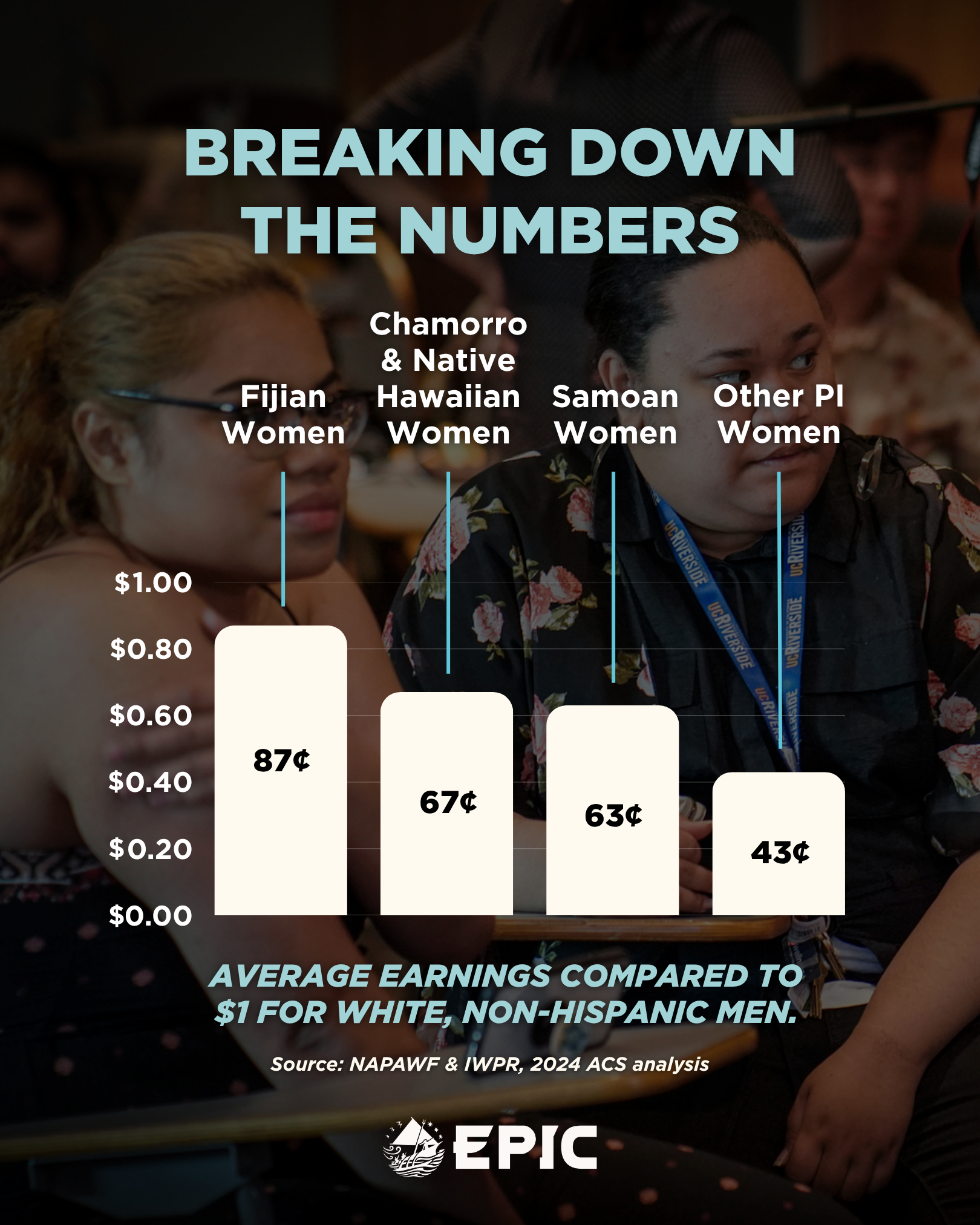
Yet the full picture is often hidden. Aggregated data that lumps Native Hawaiians and Pacific Islanders (NHPI) together with Asian Americans (AA) masks deeper inequities. Disaggregated data reveals significant pay disparities across NHPI communities compared to white, non-Hispanic men:
Fijian women: 87¢ for every $1
Chamorro and Native Hawaiian women: 67¢ for every $1
Samoan women: 63¢ for every $1
Other PI women: 43¢ for every $1
Without accurate, community-specific data, the wage gap is misunderstood, and NHPI women are left out of the solutions.
These disparities are compounded by intersection structural barriers. Immigration status, limited English proficiency, disability, and caregiving responsibilities can all restrict NHPI women’s access to stable, well-paid work–pushing many into lower-wage or informal sectors with few labor protections (NAPAWF 2026).
Vision
Every person deserves the ability to live, work, and make decisions about their future without the burden of economic insecurity. Fair wages and safe working conditions allow NHPI women to thrive and provide for themselves, their families, and their communities. By voting for leaders who champion economic justice in the upcoming midterm elections, we can accelerate this future and ensure our communities are heard.
Problem
NHPI women experience one of the largest wage gaps in the nation and remain far from reaching pay equity.
NHPI women continue to face higher rates of unemployment, creating barriers to financial independence and long-term stability.
Data aggregation hides disparities within NHPI subgroups. Communities lumped into “Other Pacific Islander” categories–who earn as little as 43¢ for every $1 paid to white, non-Hispanic men–are often left invisible in policymaking and chronically under-resourced.
Recent federal actions—such as the EEOC's July 2026 proposal to rescind EEO-1 through EEO-6 data collections, alongside the removal of other federal datasets and the disbanding of advisory committees—have fundamentally undermined our ability to identify patterns of systemic discrimination. This erosion of transparency makes it significantly harder to target solutions, secure workplace protections, and deepen equity for our communities.
Core Message
NHPI women cannot afford to wait any longer. They deserve equal pay, strong worker protections, and opportunities to build economic security. Ending wage disparities requires both accurate, disaggregated data and comprehensive policies such as access to paid leave, higher pay, and childcare support, that break patterns of discrimination and strengthen workplace protections. As the midterm elections approach, we urge our communities to vote for leaders who champion economic justice and will fight to secure these essential protections for NHPI women.
Policy & Systems Calls to Action
-
Vote for leaders who will champion and strengthen workplace protections and enforce equal pay policies that ensure economic justice for all NHPI women. NHPI women have one of the lowest voter turnouts across the country, but we can change this. Take action here to learn about who your representatives are, who is running, and whether you are registered to vote.
-
Disaggregated data makes it clear: not all NHPI communities experience pay equity the same way. That’s exactly what’s at risk with a proposed Census Bureau rule right now. It would restrict demographic questions, ending the collection of race and ethnicity data for the first time since 1790, alongside broader changes to who gets counted in the 2030 Census. Without it, we lose the ability to show that Fijian, Chamorro, Samoan, and other Pacific Islander women face very different wage gaps, and we lose the evidence needed to fight for policies that protect them. Tell the Commerce Secretary to stop this rule.
This is especially important for NHPI women and families. Data disaggregation helps expose the different economic realities faced by our many communities. Tell Congress to collect disaggregated NHPI data.
Tell Congress to protect federal datasets and demand transparency from agencies.
Social Media Toolkit
Join the Call to Action: On Tuesday, September 15th, EPIC and partners will post on social media using the primary hashtag #NHPIWomensEqualPayDay, secondary hashtags #EqualPayDay, #NVRD, #PayGap, #GenderEquality. Use our toolkit below to participate and raise awareness about wage equity for NHPI women.
Today is also National Voter Registration Day, remember that your vote is one of the most powerful tools to demand economic justice and hold representatives accountable.
Graphics
Use the following graphics in your social media advocacy to highlight the pay disparities faced by NHPI women. These visuals are designed to raise awareness, spark conversation, and call on policymakers and systems leaders to take action toward pay equity and economic justice.
Captions
Use the following sample captions to strengthen your advocacy on social media. These captions are crafted to highlight the wage disparities faced by NHPI women and call on policymakers and systems leaders to take meaningful action toward pay equity and economic justice.
Don’t forget to tag us @empoweredpi and @equalpay2dayorg on Instagram, or Empowering Pacific Islander Communities on Facebook and LinkedIn!
-
NHPI women earn just 67¢ for every $1 paid to white, non-Hispanic men–and some face even wider gaps. Pay equity can’t wait. #NHPIWomensEqualPayDay #EqualPay #PayGap #GenderEquality #Vote
-
For every $1 paid to white, non-Hispanic men, NHPI women earn as little as 67¢ (or 59¢ when counting part-time and part-year workers). Disaggregated data shows some NHPI communities face steeper gaps. Not all communities experience pay equity the same way. We need policies that protect NHPI women and close the gap. #NHPIWomensEqualPayDay #EqualPay #PayGap #GenderEquality #Vote
-
NHPI women overall are paid just 67¢ for every $1 paid to white, non-Hispanic men–and disaggregated data reveals even wider gaps for many NHPI communities, with some losing hundreds of thousands—sometimes millions—over their lifetimes. This is not just about numbers; it’s about whether women can provide for their families and thrive in their communities. Today we demand action from policy makers and systems leaders: disaggregate the data, enforce equal pay, and strengthen worker protections. Share this message and stand with NHPI women. #NHPIWomensEqualPayDay #EqualPay #PayGap #GenderEquality #Vote